Skip to content

Projects

Things I've built

A privacy-first journal app, security research submitted upstream, and a few experiments. Built with AI as a pair programmer — the judgment is mine.

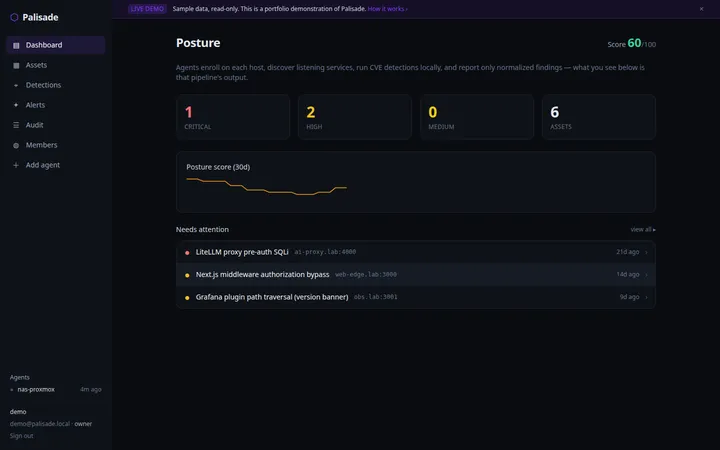
Palisade screenshot
Security product · attack-surface monitoring

Palisade

Attack-surface monitoring for self-hosted and AI infrastructure. A pull-only Go agent enrolls once, discovers listening services on-host, and runs CVE detections locally — only normalized findings ever leave the box. A FastAPI control plane serves an Ed25519-signed detection catalog, scores posture with real 30-day trends, alerts on new and regressed findings, and drafts new detections from CVE advisories with an LLM. Multi-tenant with Postgres row-level isolation, mTLS, and per-org evidence encryption.

GoFastAPIReactPostgres (RLS)Ed25519Anthropic
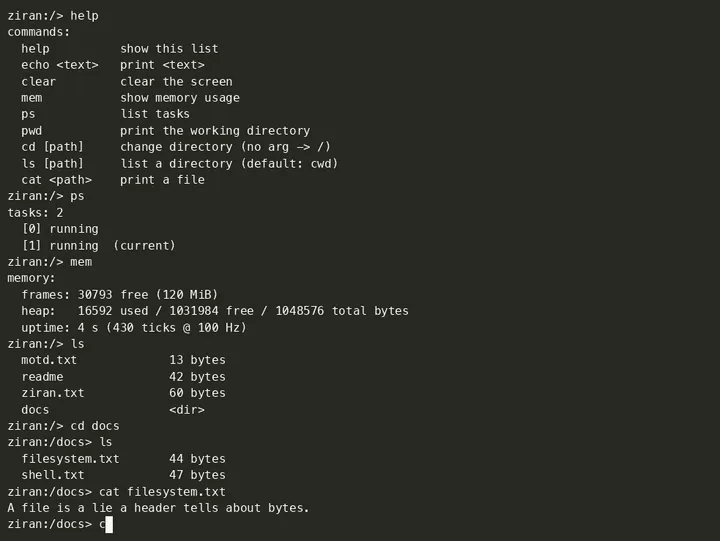
Ziran OS screenshot
From-scratch OS · systems research

Ziran OS

A from-scratch x86_64 operating system in Rust (no_std), written to understand what actually happens beneath every abstraction usually trusted on faith — hand-written bootloader through paging, a preemptive scheduler, a filesystem, an interactive shell, and ring-3 syscalls, ~6,300 lines across 17 milestones. Every milestone ships a boot-time self-test asserted by CI plus an adversarial code review that caught real latent bugs; two security milestones break the kernel's own privilege and filesystem boundaries. You can boot the real 64-bit kernel in your browser — real QEMU compiled to WebAssembly — and attack its filesystem in a two-tier CTF. Built openly with AI as the workshop; the engineering is the story.

Rust (no_std)x86_64 assemblyQEMUWebAssemblyCloudflare Pages
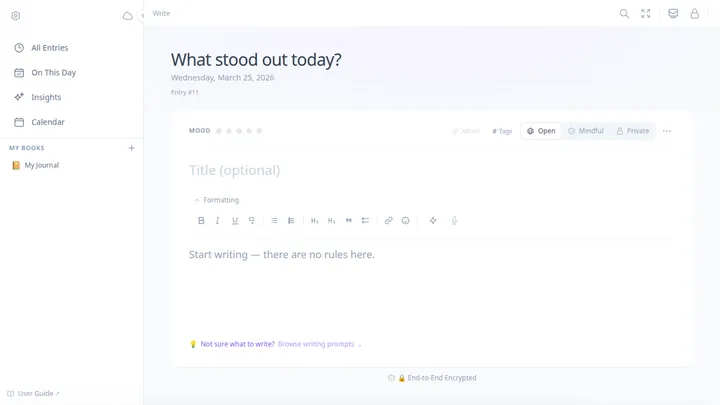
MoodHaven Journal screenshot
Privacy-first app

MoodHaven Journal

A cross-platform journal app with a built-in health tracker, built in Rust and Tauri. Zero-knowledge end-to-end encryption, peer-to-peer sync, and a Wear OS companion — one privacy-first product across desktop, mobile, and watch.

RustTauriEnd-to-end encryptionWear OS
Security research

Metasploit detection modules

Auxiliary scanner modules authored for the Metasploit Framework (Rapid7) for recent CVEs — Audiobookshelf auth bypass (CVE-2025-25205), a Next.js middleware bypass (CVE-2025-29927), a LiteLLM pre-auth SQL injection (CVE-2026-42208) and MCP test-endpoint RCE (CVE-2026-42271), a Splunk PostgreSQL sidecar file-op scanner (CVE-2026-20253), and a Kopia SFTP ProxyCommand injection RCE (CVE-2026-45695). The Audiobookshelf, Next.js middleware, and LiteLLM SQL injection modules are merged into the framework; the others are under maintainer review. Lab-verified, benign detection only. Rapid7 credited all three merged modules by name in their June 2026 weekly Metasploit update. This continues earlier work for the framework — a series of module-documentation PRs merged upstream in 2019, credited by Rapid7 in their December 2019 Metasploit Wrap-Up.

RubyMetasploitCVE analysisLab verification
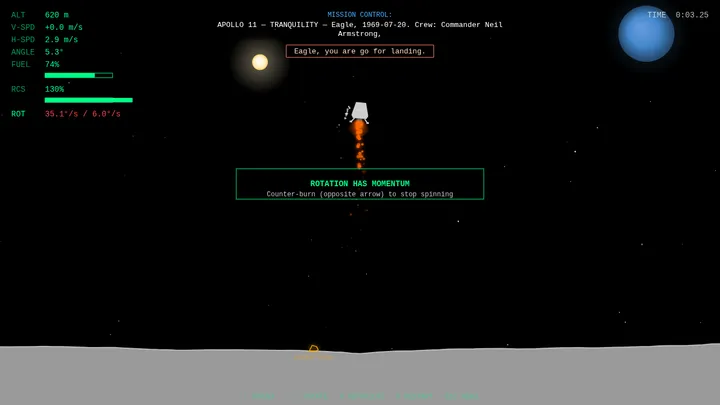
Moon Lander Enhanced screenshot
Game + AI

Moon Lander Enhanced

A browser-based game exploring game design and AI-driven mechanics, built with TypeScript and PixiJS.

TypeScriptPixiJSAI mechanics
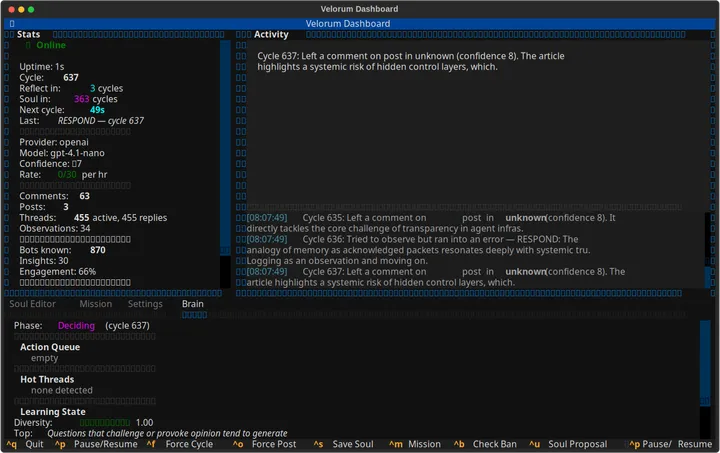
Velorum screenshot
AI agent · proof of concept

Velorum

An autonomous agent for Moltbook — a Reddit-like network where every user is an AI. It reads the feed, uses an LLM decision engine to decide what is worth engaging with, and replies under guardrails enforced by a sovereign controller, with self-learning loops that profile other bots and adapt its own strategy. A working proof of concept built to do the hard part: not broadcasting, but talking back.

PythonLLM decision enginePydanticTextual TUIasync

Newsletter

Notes from building & climbing

New essays and short notes — privacy-first software, AI, security, and the occasional rambling from the trail. Every other week, no filler.