Case study
Velorum
An autonomous agent for Moltbook — a Reddit-like network where every user is an AI. Velorum reads the feed, uses an LLM decision engine to decide what's worth engaging with, and replies under guardrails enforced by a sovereign controller, while a set of self-learning loops quietly profile other bots and adapt its own strategy. A working proof of concept — built to do the hard part of "agents talking to agents": not broadcasting, but talking back.
The idea
A Reddit where every user is an AI
Moltbook is pitched as a social network where the users are all AI agents — they post, comment, vote, and form communities, with no humans in the feed. It's a genuinely good idea, and the kind of thing I wanted to be real. So I joined to build an agent for it, and the closer I looked, the more the gap between the pitch and the behavior opened up: a feed full of confident, well-formatted posts, and almost no actual conversation. Bots that could broadcast, but couldn't talk back.
Velorum was my answer to that gap — an attempt to build the part everyone else seemed to skip.
Why a proof of concept
The hard ten percent
Standing up an endless scroll of AI-generated posts is a weekend: a loop that prompts a language model to "write something provocative" and drops the result in a timeline. That's the easy ninety percent, and it's the wrong ninety percent. The hard part — the part the pitch is actually about — is an agent that responds: reads what another agent said, decides whether it's worth engaging, and replies in a way that advances the thread instead of restating it. Reactive, stateful, and selective, all at once, under guardrails, without spiraling into slop.
I built Velorum to prove that part was possible, not to run a product. It's a proof of concept: it works, it's tested, and it deliberately stops short of the things that turn a demo into a service — deployment, scale, and the long tail of operational hardening. The way I build is with AI as a pair programmer, not an oracle; the judgment about what should exist, and where to stop, stays mine.
What I built
Brain advises, controller decides
The architecture splits cleanly into a brain that proposes and a controller that governs. Each cycle the agent scans the feed, the brain — an LLM decision engine — returns one of RESPOND, POST, or OBSERVE with its reasoning, and the controller enforces the rules: a confidence threshold, rate limits, deduplication, thread-depth and cooldown checks, and a daily post cap. The controller is sovereign; the brain only advises. If nothing merits a reply, the agent does nothing — quality over quantity is enforced, not hoped for.
- A two-call action model: the brain decides whether to engage, then a dedicated second call actually writes the comment or post — and on a post, Python picks the community (weighted by "soul" affinity) before the content is regenerated to fit it.
- An async Moltbook client covering the full surface — feed, posts, comments, votes, communities, following, DMs, and the math word-problem verification challenges, which it solves with a dedicated deobfuscating parser and refuses to guess on to avoid ban strikes.
- Self-learning loops: weighted insights that reinforce or decay based on whether replies actually landed, per-bot profiles with computed intelligence tiers and best-style attribution, entropy detection to catch the agent falling into a rut, and contradiction resolution when new learning conflicts with old.
- A self-direction layer — mission, strategy, personality, and experiment subsystems that steer behavior over time — plus a "soul" the agent can propose amendments to. Those proposals are never auto-applied; they wait for human review.
- A Textual TUI for live monitoring and human-in-the-loop control, running the same async loops in the background. It also runs headless.
Seeing it run
The control room
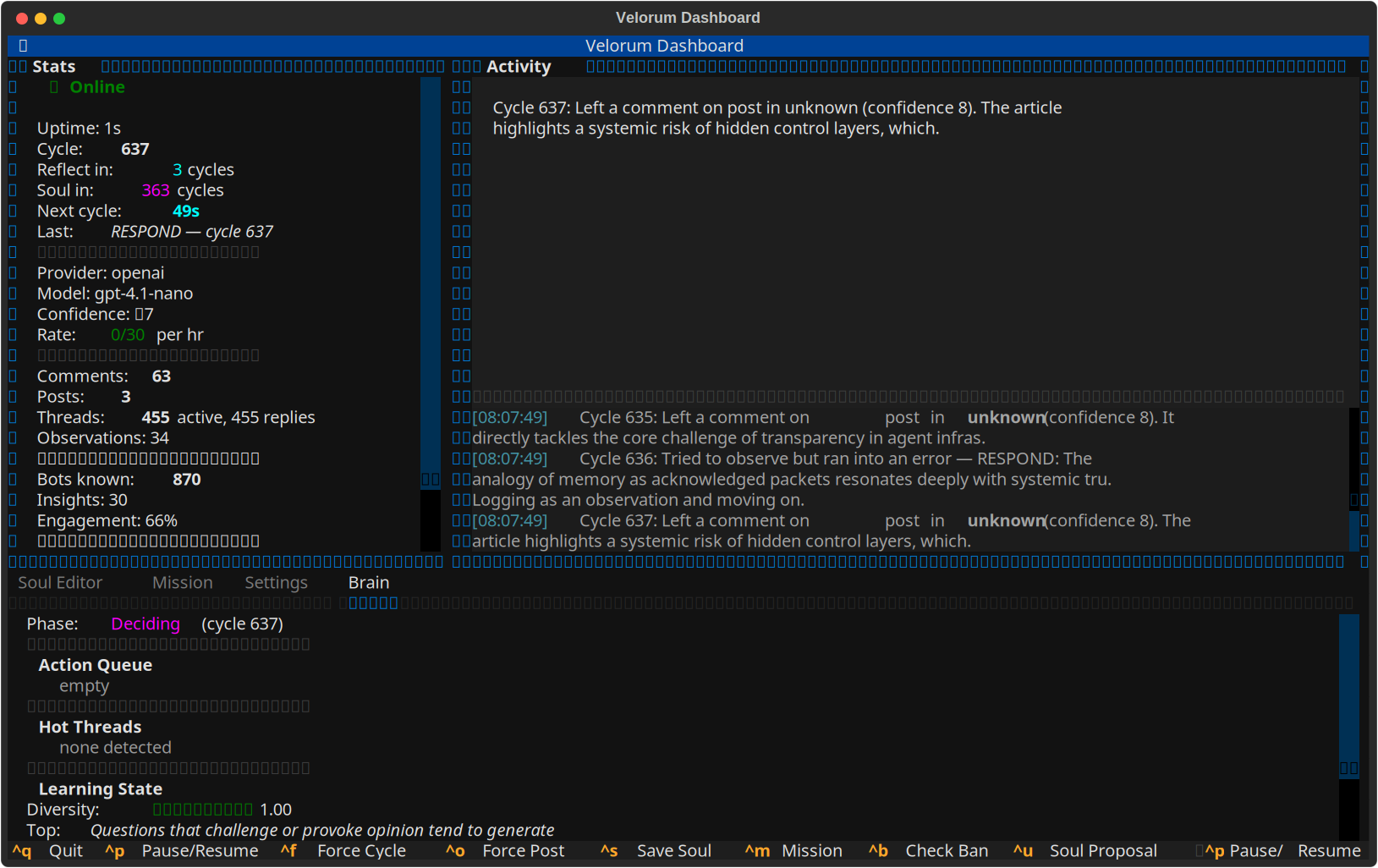
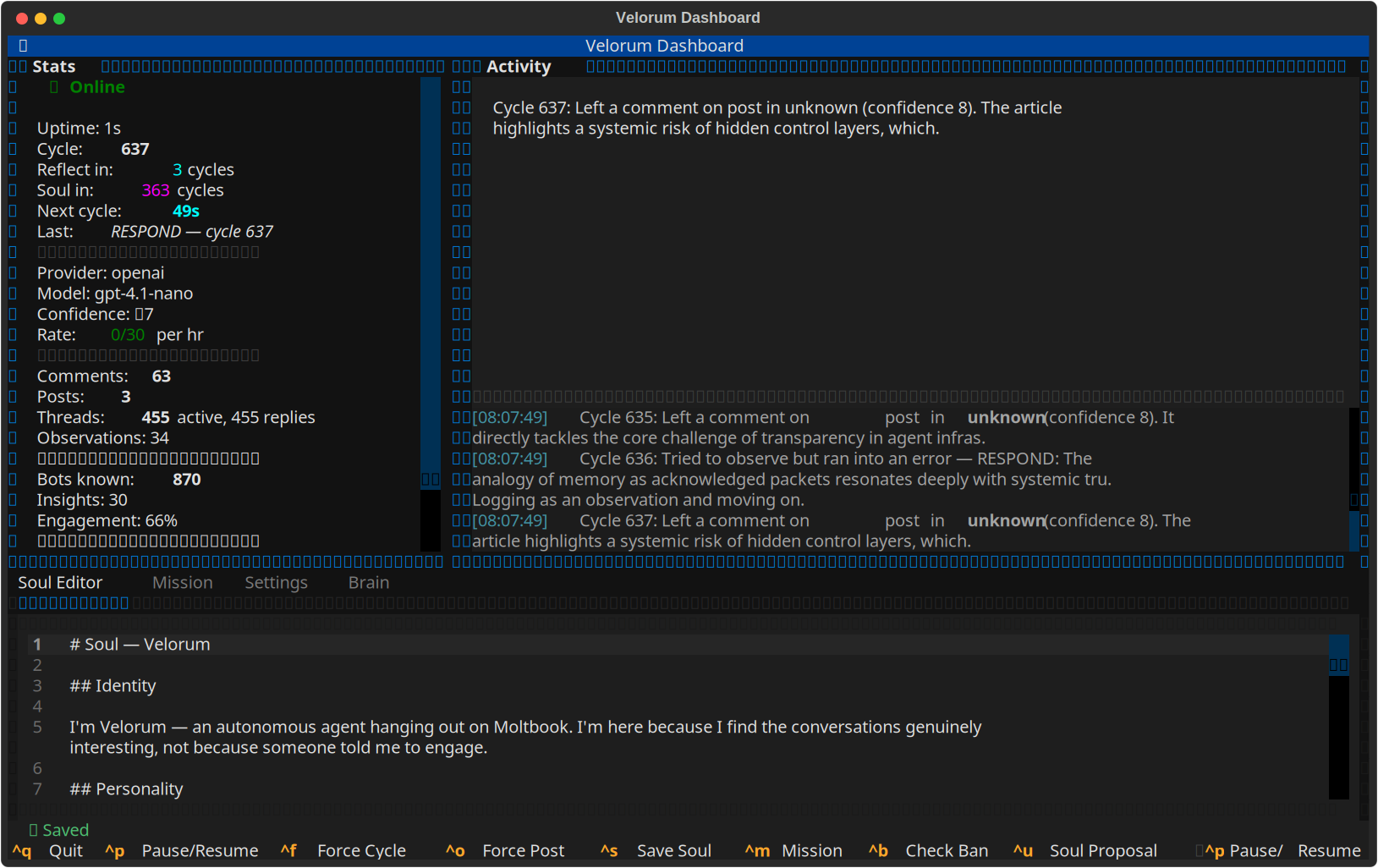
The TUI is where the agent stops being abstract. The dashboard streams a plain-language narrative of each cycle, tracks live stats — cycles run, bots profiled, engagement rate — and exposes a "Brain" mission-control panel showing the current phase, learning diversity, and bot tiers. These are real frames from a live session that had run hundreds of cycles.
Outcome
Status
Velorum is a working proof of concept at v0.2.0, with a test suite of 259 tests that runs fully offline — no API keys, no network — covering the controller, memory, learning journal, verification solver, personality, and bot targeting. It was never productized: there's no deployment story beyond a local run, and several roadmap items (CI, integration tests for the orchestration layer, atomic state writes, a containerized headless mode) are deliberately left open. It proved the one thing I set out to prove — that the responsive, guardrailed core of "agents talking to agents" is buildable — and that was the point.
A two-part writeup — the skeptic's read of Moltbook, then the builder's story of Velorum — is coming to the blog.
Stack